

Three Wars. Three Trade Shocks. One Lesson.
Every major conflict in the Middle East and beyond since 1990 has redrawn trade routes, redefined risk premiums, and accelerated or disrupted the cross-border services economy. The HR Tech and consulting industry, particularly firms operating across the UK, EU, UAE, and India, has navigated each of these shocks. The question in 2026 is: are we learning from them?
Gulf War (1990–1991): Operation Desert Storm
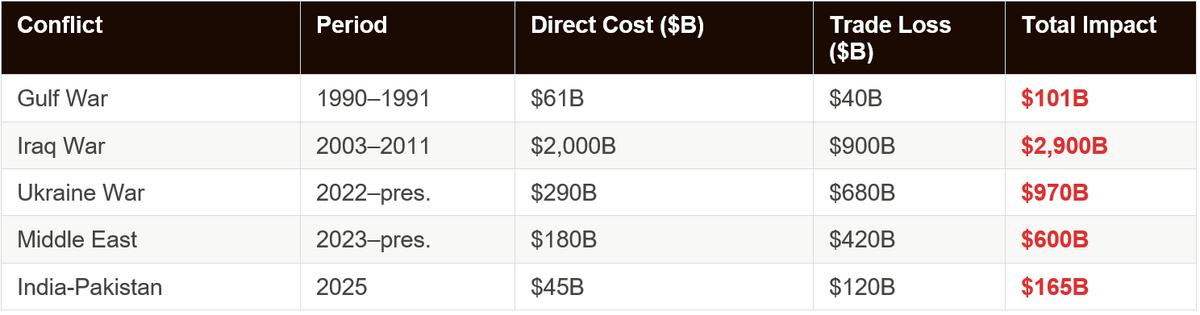
Iraq's invasion of Kuwait sent crude prices from $17 to $46/barrel. An estimated 800,000+ Indian nationals were evacuated from Kuwait and surrounding regions. Global air freight costs surged 300%. Suez Canal traffic dropped 15%. The nascent IT outsourcing industry faced its first real test of geographic risk diversification.
Iraq War (2003–2011): Operation Iraqi Freedom
The US-led invasion fractured the post-Cold War multilateral trade architecture. Reconstruction contracts worth $100B+ excluded non-coalition nations, a direct precursor to today's 'friendshoring' doctrine. Insurance premiums for regional operations rose 40–60%. This era coincided with the first major Oracle HRMS wave, as enterprises scrambled to manage dispersed, multi-jurisdiction workforces, driving demand for global HCM platforms.
Multi-Front Volatility (2022–2026): Ukraine, Middle East, India-Pakistan, Taiwan Strait
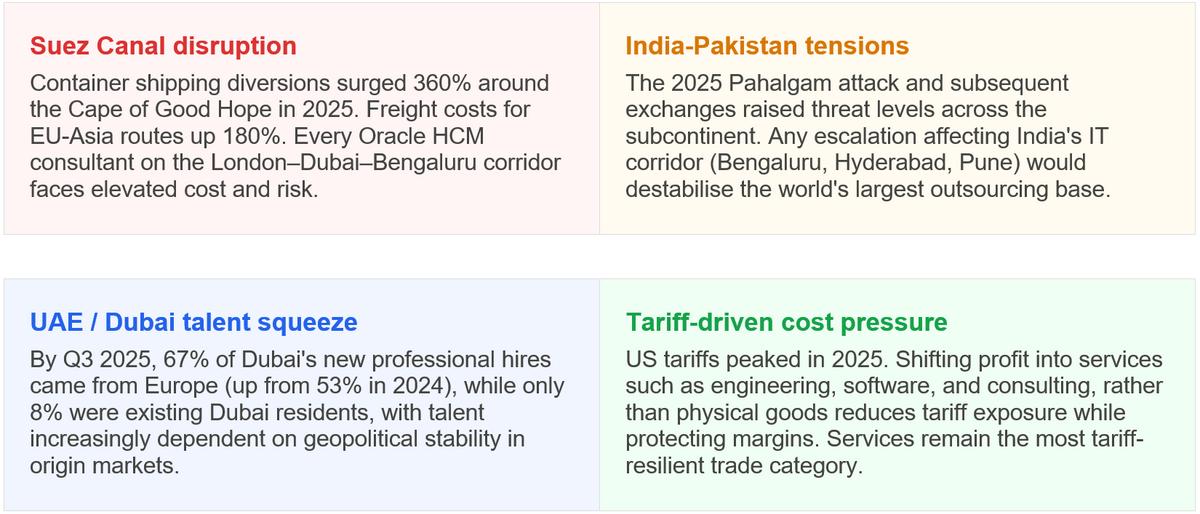
Four simultaneously active conflict zones. Russia-Ukraine has displaced 200,000+ tech workers. Middle East conflict disrupted Suez Canal shipping, which covers 12% of global trade, with container diversions surging 360% around the Cape of Good Hope. India-Pakistan tensions remain elevated post-2025 Pahalgam attack. Taiwan Strait friction triggered US-China export controls. 41% of supply chain leaders now rank geopolitical instability as their single biggest trade challenge.
Economic cost of major conflicts: direct & indirect trade impact ($B, est. 2024 USD)
The World Is Not at Peace. Your Supply Chain Isn't Either.
The current era features simultaneously active conflict zones across four strategic regions. For HR Tech consultancies whose delivery models depend on cross-border talent movement, client travel to events, and multinational engagement contracts, this is not abstract policy risk; it is operational reality.
79% of organisations identify tariffs, sanctions, and export controls as major external factors increasing their business risk exposure. Policy direction is being driven by executive action, emerging national security priorities, and supply chain pressures that require companies to rethink how they structure cross-border trade.
"We find ourselves in a paradox. Organisations are more globally connected than ever, yet operating in an increasingly fragmented and unpredictable geopolitical environment that is fundamentally altering risk calculations."
— Sunny Mann, Global Chair, Baker McKenzie (Global Disputes Forecast 2026)
Outsourcing Doesn't Pause for War. Here's Why It Shouldn't.
Every historical conflict cycle since 1991 has been followed not by a contraction of cross-border services trade; instead, it accelerated. The outsourcing industry grew through 9/11, through the Iraq War, through the 2008 financial crisis, through Covid, and is growing through the current multipolar conflict environment. The reason is structural, not accidental.
The global outsourcing market is expected to reach $854.6 billion in 2025. 92% of G2000 companies outsource IT; 59% outsource business processes. Critically, cost reduction as the primary driver has dropped from 70% in 2020 to just 34% in 2024, replaced by access to skilled talent as the dominant rationale.
In Oracle HCM and HR Tech consulting, this shift is even more pronounced. Certified Oracle HCM practitioners are globally scarce, with fewer than 12,000 worldwide. In periods of geopolitical volatility, enterprises don't cancel HCM transformation programmes; they accelerate them, seeking efficiency, workforce visibility, and payroll resilience.
Cost Optimisation Without Quality Compromise: The India Equation
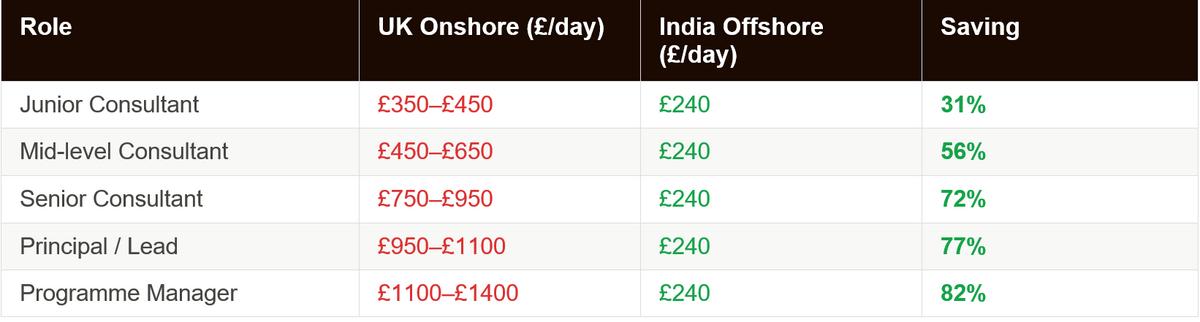
For UK and EU enterprises running Oracle HCM Cloud, the fully loaded cost of a senior consultant onshore (UK) runs £750–£1,100/day. A comparably credentialed India-based consultant runs £240/day (Axle HRM), representing a up to 82% cost differential with no compromise on Oracle certification, English fluency, or delivery quality.
NASSCOM’s 2024 data shows Tier 2 Indian city delivery teams maintain 28% higher retention rates than metro counterparts, meaning lower churn mid-engagement, more institutional knowledge retained, and better client continuity. Around 70% of UK B2B organisations now outsource key business functions.
Oracle HCM consultant daily rate: UK onshore vs. India offshore (£/day, 2025)
Dubai Is Hiring. The Region Is Volatile. The Paradox Is Real.
Dubai draws 5,500+ HR professionals annually to HRSE Dubai and 400+ global L&D leaders to ATD Middle East. The city continues to attract Oracle ecosystem partners and HCM consultants at scale. But by Q3 2025, 67% of Dubai's new professional hires came from Europe while only 8% were Dubai residents, showing an increasing dependence on international mobility that any regional escalation could snap.
Risk Signal: Dubai HR Tech Events 2026
HRSE Dubai, ATD Middle East, and HR Leaders Conference Dubai all aggregate consultants, vendors, and enterprise buyers from conflict-adjacent geographies. Any escalation involving Iran, Yemen, or Israeli proximity operations directly impacts air corridor safety, visa issuance, and attendee participation from India and South Asia, the primary Oracle HCM consultant supply pool for MENA.
In the UAE, only 49% of employees trust their employers to foster thriving cultures (Randstad 2025 Workmonitor), and the 'Great Employee-Leader Disconnect', with mentions of misalignment in reviews up 149% from 2024 to 2025, which suggests organisational resilience in the region is structurally fragile even before adding geopolitical stress.
What Conflict Does to HR Tech Summits in the UK and EU
HR Technology Europe (Amsterdam), UNLEASH World (Paris), CIPD Annual Conference (Manchester), and Oracle CloudWorld Tour stops across London and Frankfurt all depend on the free movement of speakers, consultants, and enterprise delegates from India, UAE, and conflict-adjacent zones.
Ukraine's conflict has already demonstrated the effect: Ukrainian HR Tech startups, previously a growing presence at European summits, have been essentially absent since 2022. The India-Pakistan flashpoint of May 2025 briefly triggered visa processing delays for Indian nationals travelling to UK HR events. Any escalation affecting Dubai as a transit hub directly impacts the Asia-Europe consulting corridor.

In a Volatile World, Specialisation Is the Hedge.
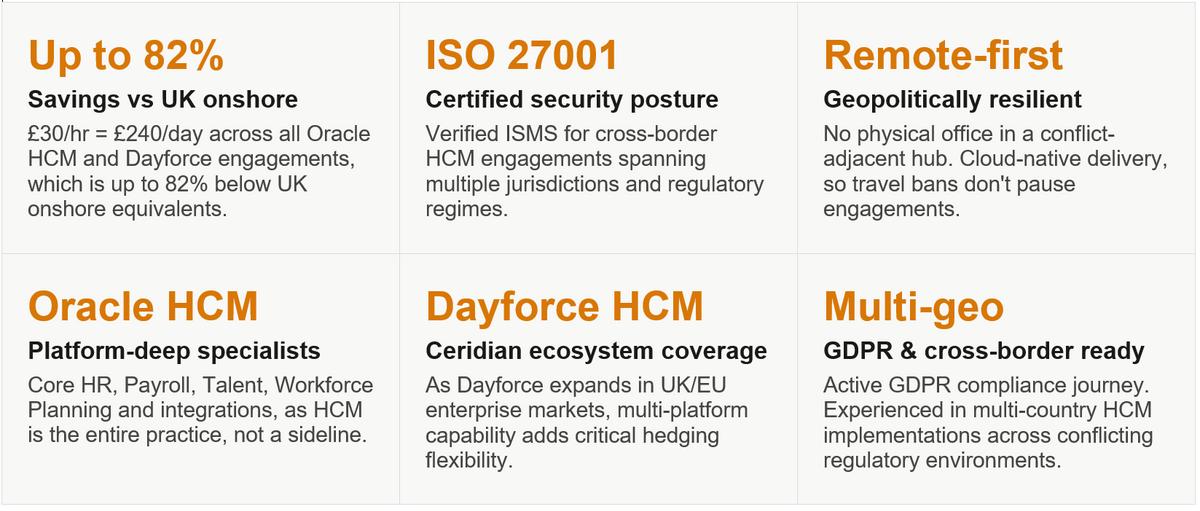
When the geopolitical environment becomes unpredictable, enterprises restructure around partners who offer specialised depth, geographic resilience, and cost-efficient delivery that large onshore firms cannot match. Axle HRM sits precisely at this intersection, being ISO 27001 certified, Oracle HCM and Dayforce specialist, India-based remote delivery, with GDPR and SOC 2 compliance journeys active.
Resilient. Specialised. Cost-Efficient.
The way forward for enterprises managing HR Tech in a conflict-fractured world is not to retreat from cross-border outsourcing; it is to upgrade the quality and resilience of those relationships around four core principles:
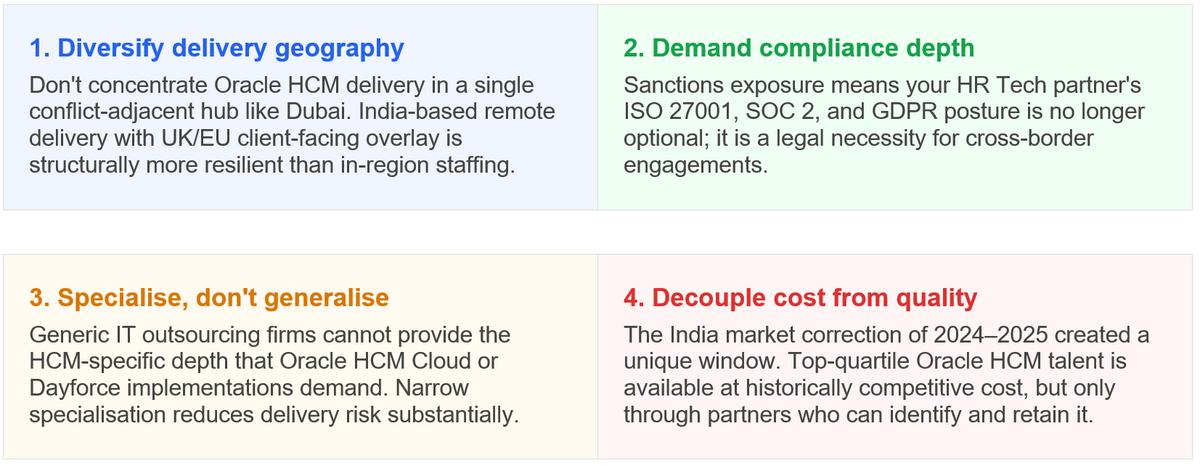
"Agility beats defence. Companies winning in volatile trade environments move fast on opportunities by reallocating capacity, entering new markets, rather than just fortifying against risks."
— Baldwin, Cordon & Evenett, IMD Business School (December 2025)