THE PROBLEM WE REFUSE TO IGNORE
Hierarchy breeds bullying. We dismantled the hierarchy.
India has a workplace bullying problem and most organisations know it. 55% of Indian employees report experiencing workplace bullying, while 94% have witnessed it directed at a colleague. The most alarming finding? Managers and bosses are over 85% more likely to be the bully than the employees below them. Workplace hierarchy doesn't just slow decisions and it creates the power gradient that makes bullying structurally possible.
At Axle HRM, we made a deliberate architectural decision: hierarchy exists only to the extent required for execution and project ownership, delivery accountability, client responsibility. It does not exist to create dominance, gatekeep opportunities, or confer social status. No one here has the right to make someone else feel small. That is policy. That is culture. And it is non-negotiable.
"Workplace bullying is the second leading cause of stress at work and the cost runs to $100,000 per year per victim in productivity, absenteeism and turnover. It is an operational problem, not just a values problem."
— Workplace Bullying Institute / Zippia Research Compilation
What does a no-dominance culture actually look like? It means junior consultants challenge assumptions in client calls and are thanked for it. It means a delivery analyst can raise concerns about a project timeline without routing through three management layers. It means no one is excluded from important conversations because of their designation. At Axle HRM, the most important voice in any room is the one with the most relevant insight — not the highest title.
Where workplace bullying originates by organisational level
Zippia Workplace Bullying Research (2024) · Global data

INCLUSION IS STRATEGY, NOT OPTICS
India's talent isn't in four cities. We hire like it.
The Indian IT and consulting sector has long operated a quiet geography of exclusion. Most opportunities — especially in niche, high-value domains like Oracle HCM — cluster in Bengaluru, Mumbai, Delhi, and Hyderabad. The assumption is that talent follows postcode. The data says otherwise.
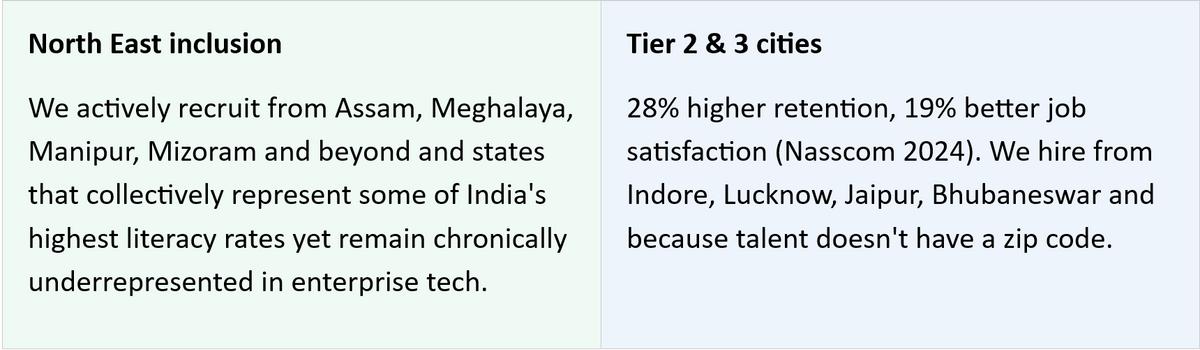
In 2024, Tier 2 and Tier 3 cities contributed 1.28 crore job applications and nearly matching the combined output of India's three largest metros. A Nasscom report found that Tier 2 employees show 28% higher retention and 19% better job satisfaction than their metro counterparts. Cities like Jaipur, Indore, Lucknow, Ranchi, and Imphal are not talent deserts and they are untapped reservoirs of ambition, skill, and drive.
Axle HRM deliberately recruits from these geographies. We actively build pipelines into North East India and a region of extraordinary intellectual diversity that the mainstream IT sector has systematically underrepresented. We do this not out of charity, but because the best HR Tech consulting teams are diverse teams.
REMOTE WORK AS A STRUCTURAL EQUALISER
Mothers should never have to choose between family and career
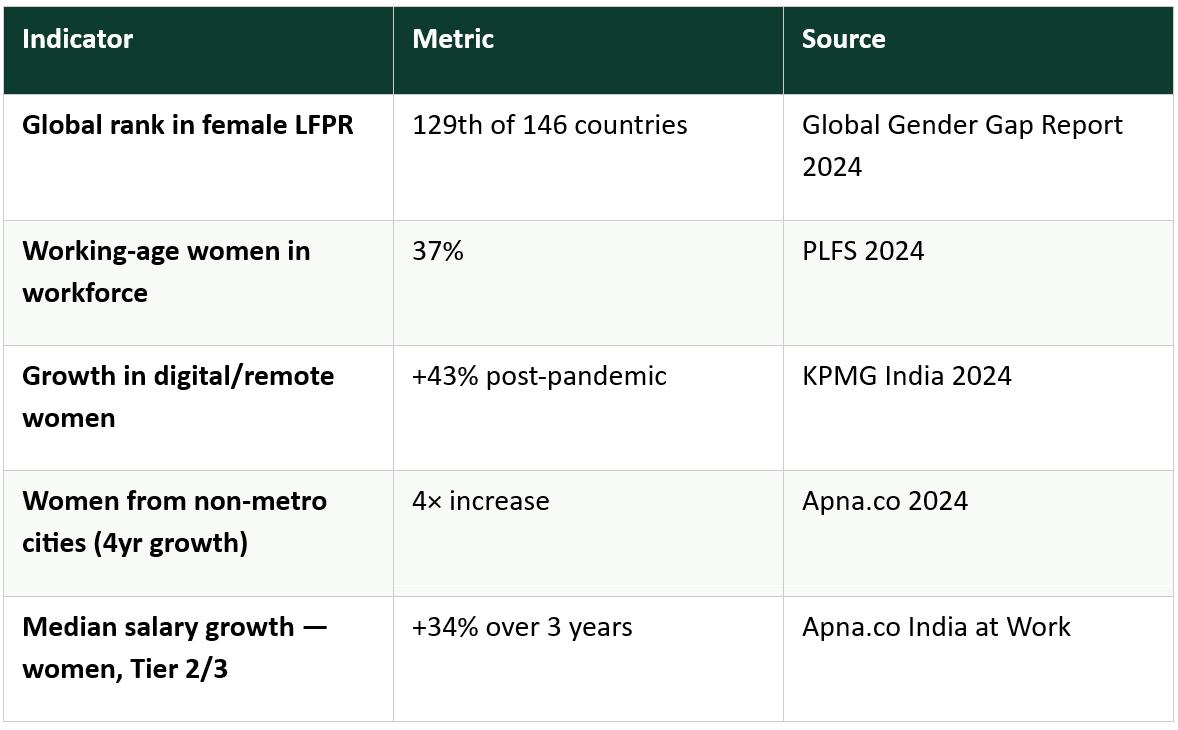
India ranks 129th in female workforce participation globally (Global Gender Gap Report 2024). Only 37% of working-age Indian women are in the workforce. The reason is not lack of ambition or capability and it is structural. Careers are designed around commuting to metros, long office hours, and constant physical presence. For women managing caregiving responsibilities and especially mothers in smaller towns and this design excludes them by default.
Remote work changes that equation. Female participation in India's digital workforce grew by 43% post-pandemic, primarily driven by women in Tier 2 and Tier 3 cities who could access meaningful work without relocating or abandoning family responsibilities. Between 2021 and 2024, women job seekers from non-metro cities grew by 4 times, with median salaries up 34% over three years (Apna.co).
At Axle HRM, remote-first isn't a Covid-era concession we're gradually walking back. It is a permanent commitment and precisely because it is the single greatest structural enabler for women in the workforce. A mother in Guwahati advising an Oracle HCM implementation for a Fortune 500 client from home is not a compromise. That is the point.
"Most women have to give up their career at some point to raise a family — and after a career break many are unable to get started owing to lack of well-paying opportunities locally unless they live in big cities."
— Priyanka Karwa, Co-Founder, Skill Arbitrage (Outlook India)
Women workforce indicators — India
PLFS / Apna.co / KPMG India 2024 · Remote work as an accelerator
THE CAREER DIMENSION
HR Tech is niche. At Axle HRM, that's your advantage.
Oracle HCM consulting is not a generalist field. Practitioners who understand payroll localisation across geographies, RBAC configuration in complex enterprise environments, or the interplay between HCM modules and GDPR compliance are genuinely rare. The niche creates depth, and depth creates careers that matter.
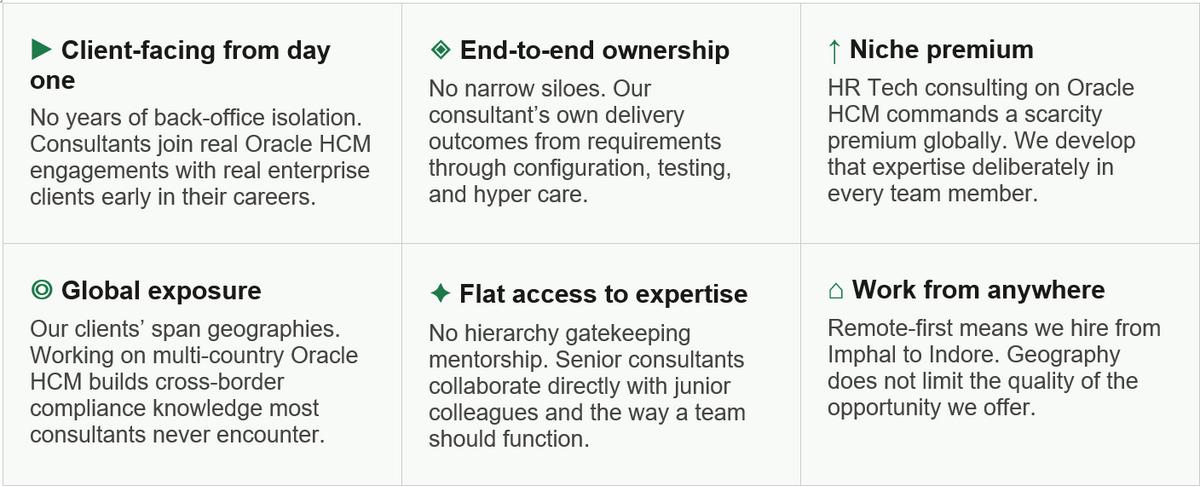
At most large IT firms, a junior consultant spends years on isolated workstreams, where they are never seeing a client, never owning a problem end-to-end, and never developing the full-stack understanding that makes someone genuinely excellent. At Axle HRM, consultants work directly with enterprise clients from early in their tenure. The work is real, the problems are hard, and the growth is fast.