

HR data is the most sensitive data in your organisation
When a company outsources HR operations like payroll, talent acquisition, workforce management, or HCM configuration, it hands a service partner the keys to its most intimate data vault. Social Security numbers. Salary bands. Performance reviews. Medical accommodations. Bank accounts.
For most enterprises running Oracle HCM Cloud, this data flows between implementation partners, managed service providers, staffing firms, and internal teams every single day. The question is not whether your data is exposed, but it's whether every party holding it is accountable to the same security standard you would hold yourself.
"Breaches involving employee PII accounted for 40% of all breached records in 2024 — at an average cost of $189 per compromised record, making them among the most expensive types of breaches organisations face."
— IBM Cost of a Data Breach Report, 2024
The cost is not just financial. Recovery from a major breach takes over 100 days for 75% of affected organisations. In HR Tech, where payroll continuity and regulatory deadlines don't pause for incidents, that timeline is catastrophic.
Key statistics at a glance

CASE STUDIES IN FAILURE
What happens when the supply chain breaks
These are not hypothetical scenarios. Each of the following incidents involved an outsourcing partner, a staffing vendor, or a third-party HR platform, and in each case, the consequences fell on the enterprise that had outsourced trust without verifying compliance.
HR SaaS Platform · 2023
UKG Payroll & HR — Sensitive Employee Data Exposed
In October 2023, UKG inadvertently shared sensitive employee information including Social Security numbers and salary details. The incident required 24 months of free credit monitoring for affected individuals. The breach underscored that no HR platform is inherently immune, and enterprises must audit every vendor's security posture independently.
Staffing Industry · 2024–2025
Manpower Franchise — 144,000 Workers Exposed by Ransomware
A ransomware group breached an independently-owned ManpowerGroup franchise, exposing data on approximately 144,189 employees and job candidates, including names, Social Security numbers, driver's licences, and passport scans. This breach illustrates the specific vulnerability at the intersection of HR outsourcing and staffing.
IT Outsourcing → Financial Services · 2024
Fidelity via Infosys McCamish Systems — 28,000+ Customers Compromised
A cyberattack on Infosys McCamish Systems, a third-party vendor used by Fidelity Investments, led to the exposure of over 28,000 customer records. The lesson: your compliance posture is only as strong as your weakest outsourcing partner.
Retail Outsourcing · 2025
Marks & Spencer — £300M Loss Linked to IT Outsourcing Partner
A major cyberattack devastated M&S retail operations in May 2025. Potentially linked to vulnerabilities in M&S's IT outsourcing partner Tata Consultancy Services, the breach is expected to cause a £300 million ($400M) profit loss, making it the largest documented financial impact tied to an outsourcing security failure in recent history.
Recruitment Platforms · 2023–2024
"ResumeLooters" — 2M+ Job Seekers Across Asia-Pacific
A criminal group infiltrated 65+ recruitment websites using SQL injection and cross-site scripting, stealing over 2 million records including names, phone numbers, and employment histories. For organisations using these platforms as staffing intake pipelines, candidate data was compromised without any direct breach of their own systems.
COMPLIANCE FRAMEWORK
The three dimensions every HR Tech partner must be measured against
When evaluating an HR technology or outsourcing partner, particularly one with access to your Oracle HCM environment, compliance cannot be taken on trust or treated as a vendor self-assessment. Below are the three global standards that define a genuinely secure HR Tech partner.
Compliance scorecard: what each standard covers in HR Tech contexts
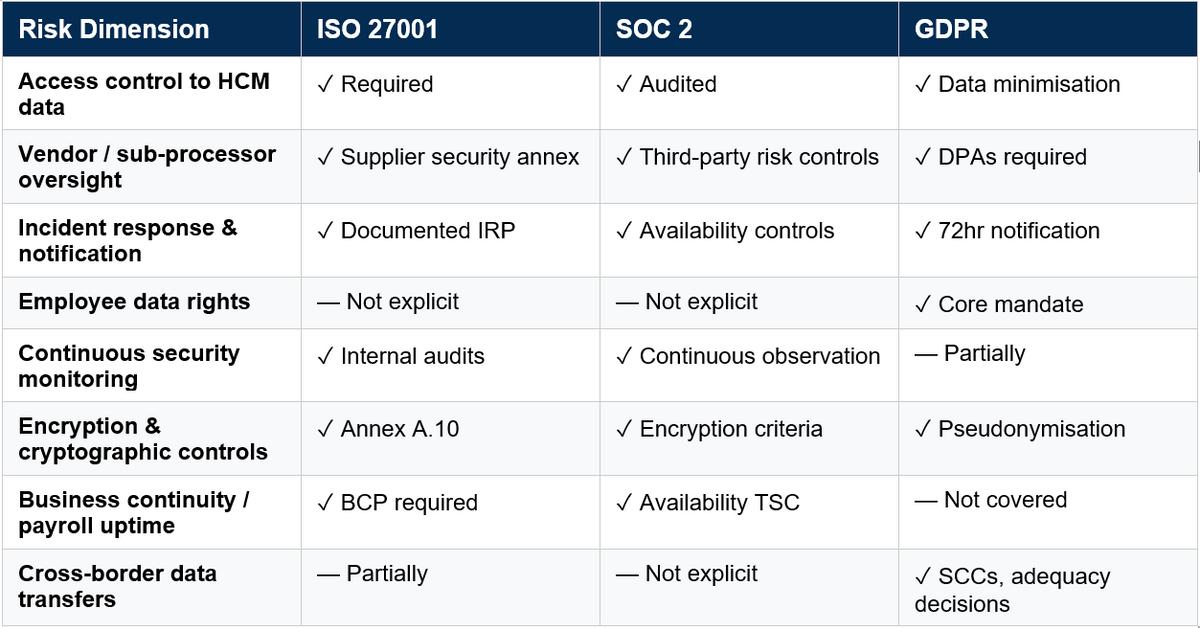
Importantly, these frameworks are complementary, not redundant. ISO 27001 governs the security management system. SOC 2 validates the operational controls in practice. GDPR governs the rights of the individuals whose data is processed. An enterprise that demands all three from its HR Tech partners has closed the major vectors of exposure.
ORACLE HCM CLOUD
Why compliance is non-negotiable in Oracle HCM implementations
Oracle HCM Cloud is one of the world's most comprehensive enterprise HR platforms, managing everything from global payroll and workforce planning to talent acquisition and succession. Organisations that implement Oracle HCM entrust the system with their most sensitive workforce data across multiple geographies, legal jurisdictions, and regulatory environments.
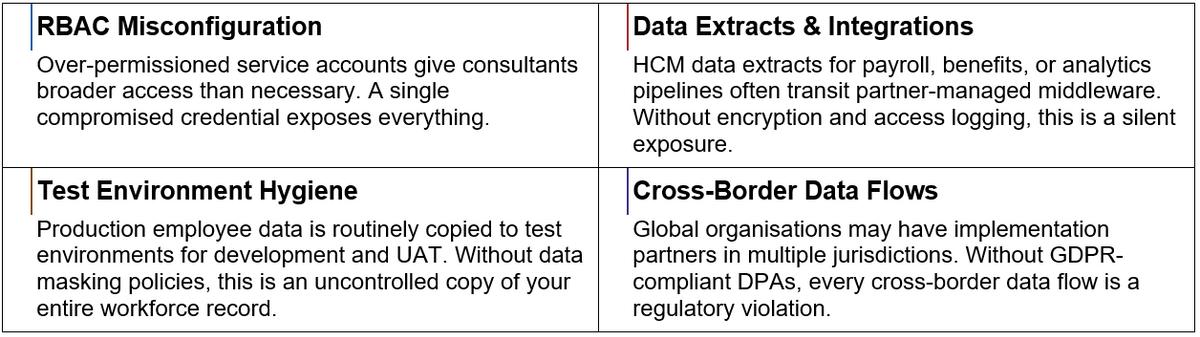
Implementing or operating Oracle HCM requires navigating layered security controls: Role-Based Access Control (RBAC), data masking, consent management for GDPR workflows, automated data disposal, and audit trails across every HR transaction.
"Businesses using Oracle HCM Cloud must ensure compliance with GDPR requirements — including consent for data processing, data access and deletion rights, and appropriate data security measures — and this obligation extends to every implementation and managed service partner."
— Oracle HCM Cloud compliance documentation
Oracle HCM risk surface — where partner compliance matters most
STAFFING & SUPPLY CHAIN
The compliance obligation runs further than you think
Most enterprises focus compliance scrutiny on their primary software vendors. Far fewer apply the same rigor to their staffing partners, subcontractors, and supplier intermediaries, yet this is precisely where the most damaging recent breaches have originated.
Consider the data footprint of a typical staffing engagement: a candidate submits a CV and identity documents. The recruiter processes them through an ATS that feeds into Oracle HCM. A background screening vendor runs checks. A payroll outsourcer processes the first payment. A managed service firm supports the onboarding workflow. At every handoff, employee PII is in motion, and each party carries the compliance obligation alongside the data.
"At least 36% of all data breaches in 2024 originated from third-party compromises — up 6.5% year-on-year, and likely understated since third-party breaches are frequently misattributed."
— SecurityScorecard / IBM, 2024
For organisations in India, where the IT and BPO outsourcing industry processes HR data for enterprises globally, this creates both a significant opportunity and a significant obligation. The partners most likely to win enterprise trust in the coming decade will be those who can demonstrate compliance maturity that matches or exceeds their clients' own internal standards.
AXLE HRM
Why Axle HRM is the compliant choice for Oracle HCM
Axle HRM is an ISO 27001 certified HR Tech partner specialising in Oracle HCM Cloud, and is one of a small number of implementation and managed service providers in the region to hold this certification. This is not a project-level commitment; ISO 27001 requires a certified information security management system governing every engagement, every team member, and every process that touches client data.
ISO 27001
Certified information security management
Every Oracle HCM engagement is governed by a certified ISMS. Access controls, encryption, incident response, and supplier oversight are third-party audited, not self-declared.
SOC 2
Continuous controls assurance (in progress)
We are pursuing SOC 2 Type II attestation to provide clients with independent, ongoing assurance that operational security controls remain effective.
GDPR
Data subject rights & global compliance
We are building data processing frameworks, consent management workflows, and cross-border transfer safeguards required by global enterprises.
Oracle HCM
Platform-specific security expertise
From RBAC configuration and data masking to GDPR-compliant data disposal, our Oracle HCM expertise is built on a foundation of security-first practice.
DUE DILIGENCE FRAMEWORK
What enterprises should demand from every HR Tech and staffing partner
Compliance is not a vendor relationship feature, but rather it is a procurement requirement. The following is a practical framework for evaluating the security posture of any HR outsourcing, implementation, or staffing partner before granting them access to your workforce data and HCM environment.
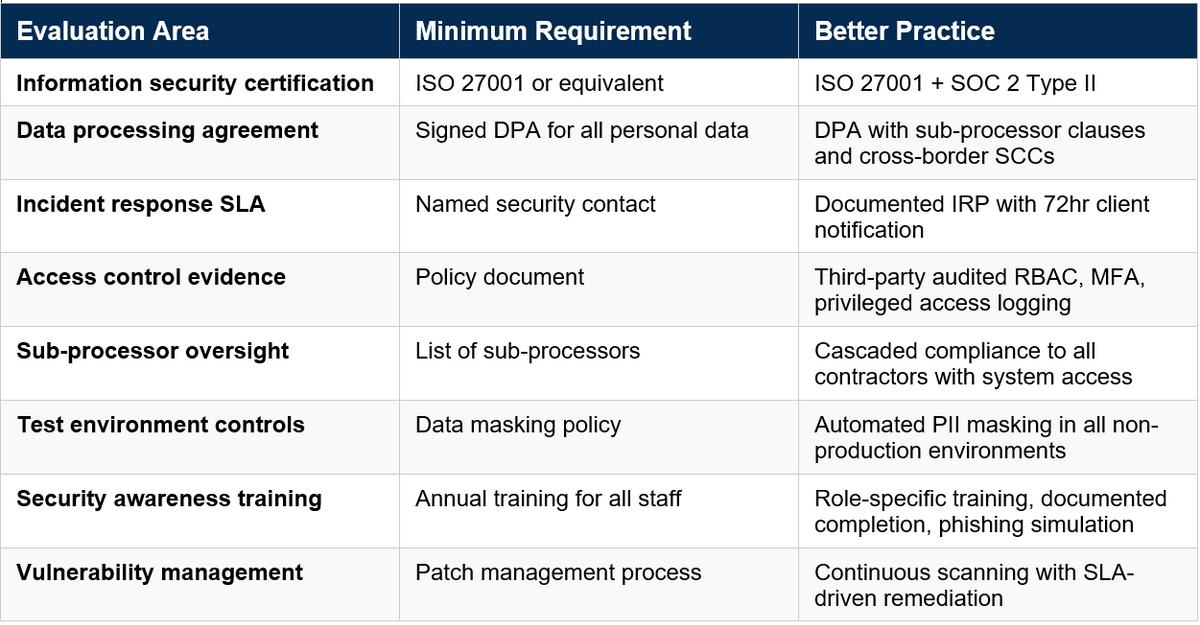
"When assessing new HR Tech partners, use a consistent framework to evaluate data security, compliance with regulations, and how they handle incidents. Prioritise vendors with transparent data security protocols and certifications like ISO 27001 or SOC 2."
— HRMS World, Six Basic HR Data Security Threats in 2026