

Oracle's Fusion Agentic Applications launched on April 9, 2026. The announcement landed with the usual vendor momentum, with revenue figures, customer counts and a compelling product story. But for the HR and HRIS leaders sitting across the table from that narrative, the more useful question is not whether the agents work. It is whether your specific Oracle environment is in a position to deploy them without amplifying the problems you already have.
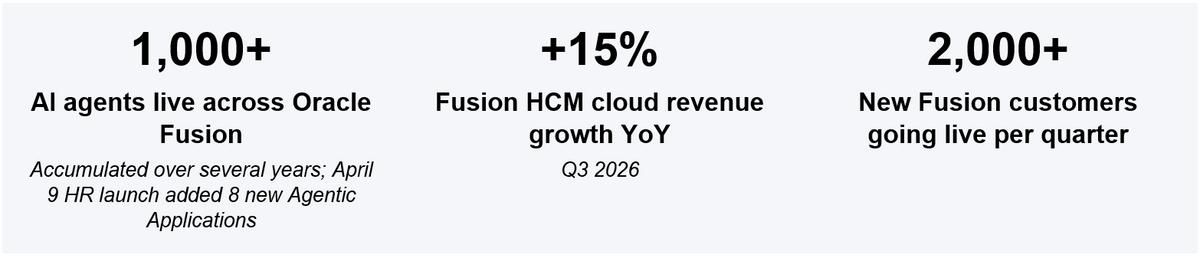
Oracle has significantly expanded the number of AI-driven capabilities and embedded agents across Fusion Applications over recent years, including HCM capabilities focused on internal mobility, career matching, payroll anomaly detection, workforce operations, and employee support. The April 9 launch added a distinct and more comprehensive tier on top of this foundation: eight new Agentic Applications for HR, which are outcome-driven workspaces powered by coordinated teams of agents. These include the Career Advancement Command Center, the Workforce Operations Command Center, the Manager Concierge Workspace, which routes team management queries across compensation, leave, talent management, and employment details, and five further applications covering hiring, employee support, learning, talent calibration, and contract compliance. Oracle describes this as natively built AI, as these applications operate directly within the system of record and are designed to execute workflows and actions within defined governance and approval structures, rather than simply surface insights. That distinction matters and it is the reason governance matters more here than it does with earlier generations of HR analytics.
The Promise Is Real. So Is the Complexity.
Oracle’s positioning is straightforward: many of these AI capabilities are presented as natively embedded within the broader Fusion ecosystem, operating on the same infrastructure and security framework as the rest of HCM. That is an architecturally coherent approach and a meaningful difference from bolting a third-party AI layer onto a system it was never designed to interact with.
But what many organizations are now evaluating beyond the product announcement is this: AI capabilities in HCM are only as effective as the configuration and operational maturity they are deployed into. An organisation running an outdated job architecture will find that its Job Discovery Agent surfaces irrelevant or misleading internal opportunities. An organisation with poorly maintained position data will find the succession planning agents reasoning from a foundation that does not reflect actual organisational structure. An organisation that implemented Oracle HCM three years ago and has not kept pace with quarterly releases will find that some of the agent capabilities they are being asked to activate depend on configuration decisions that were never made.
AI agents tend to surface existing operational and configuration gaps more visibly. They do not automatically resolve them.
What ‘Agentic AI’ Actually Means and Why It Raises the Governance Bar
Traditional AI in HCM generated recommendations that a human acted on. Agentic AI is different in a specific and important way: it initiates multi-step processes and can execute them. AI-driven payroll anomaly detection capabilities do not simply produce static reports for payroll managers to review. They are designed to proactively identify deviations within pay runs and surface contributing factors for investigation and decision-making. The workforce scheduling agents do not simply suggest staffing options. They are designed to accelerate and execute scheduling operations, reducing manual data gathering and driving approvals, within guardrails set by the organisation.
Oracle has been deliberate about keeping employees in the loop, which is correct. But ‘in the loop’ needs to be defined by the organisation, not assumed from the vendor documentation. For each workflow where an agent can act, someone needs to answer: what does human review look like here? Who holds accountability if the agent’s action is wrong? What audit trail is maintained? How does this interact with our existing RBAC configuration?
These are not technology questions. They are HR operating model and governance questions. And they need answers before activation, not after the first payroll anomaly.
Four Readiness Conditions No One Is Talking About
1. Data quality
Agents reason from the data in your system. If your skills inventory has not been maintained, your position hierarchy is outdated, or your pay element configuration has accumulated years of workarounds, the agents will produce outputs that reflect those problems accurately and at scale. Data quality work is a prerequisite for agent deployment, not a parallel workstream.
2. Configuration integrity
Oracle's quarterly release cycle has been delivering the building blocks of agentic capability for several years. Organisations that have kept pace with those releases, activating Dynamic Skills, Redwood homepages and AI-enabled Guided Journeys, are substantially more ready to deploy agents than those that have deferred updates. The gap is real and it requires honest assessment, not optimistic assumption.
3. RBAC alignment
Agents operate within the same Role-Based Access Control model as human users. If your RBAC configuration has accumulated the common structural problems, such as predefined roles used directly or security profiles applied to job roles rather than through HCM Data Roles, the agents will navigate those problems the same way a misconfigured user would. The security architecture needs to be sound before agents are added to it.
4. Accountability ownership
For every workflow where an agent can take action, the organisation needs a named accountable owner. This is an HR governance decision, not a system setting. Organisations that deploy agents without this accountability structure will discover its absence at the worst possible moment, whether during a payroll error, a compliance review, or an employee dispute about an AI-influenced decision.
What This Means for Your HRIS Partnership
Oracle's agentic applications raise the quality bar for what ongoing HCM managed service needs to look like. As Oracle's AI capabilities continue to evolve, many organisations may require ongoing advisory, governance, and optimisation support beyond traditional implementation models, particularly around AI governance, AI Agent Studio customisation, release readiness, and operational oversight.
The value of a specialist HRIS consultancy in this environment is not technical execution alone, but rather the ability to advise honestly about the gap between what the platform can do and what your specific environment is actually ready for. Those are different questions, and confusing them is expensive.
"The next battleground in HCM will centre on whether AI can execute real HR workflows inside the system of record — not just assist around the edges."
— UC Today, April 2026