

Oracle Fusion HCM is one of the most mature and robust security architectures available in the enterprise HCM market today. Its Role-Based Access Control (RBAC) model built on a structured hierarchy of Job Roles, Abstract Roles, Duty Roles, and Data Roles is purpose-designed for complex, multi-entity, multi-jurisdiction workforce environments. Its native auto-provisioning capability is reliable, well-documented, and integrated deeply with Oracle's identity management layer.
And yet, as with any rule-based system, Oracle's native provisioning framework operates within boundaries. For organizations with relatively standard workforce structures, those boundaries are rarely encountered. For organizations with complex, segmented, or multi-classification workforce populations - which describes a significant share of Oracle's global customer base - those boundaries become a real constraint.
This article examines where Oracle HCM's native provisioning model excels, where AI-augmented provisioning can extend it, why compliance frameworks increasingly demand more sophisticated access governance, and how Oracle's security architecture compares to its major competitors in the enterprise HCM market.
Oracle HCM's Native Auto-Provisioning: What It Does, and How Well It Does It
Oracle's auto-provisioning framework, managed through the Manage HCM Role Provisioning Rules task, is built on a clear and well-implemented principle: roles give users access to data and functions, and to provision a role to users, you define a relationship or a role mapping between the role and some conditions. When someone joins an organization, depending upon their grade, position, job, and reporting line, Oracle can automatically assign them certain roles.
The provisioning lifecycle is event-driven and automated. Users acquire a role automatically when at least one of their assignments satisfies the conditions in the relevant role mapping. Provisioning occurs when you create or update worker assignments. For example, when you promote a worker to a management position, the worker acquires the line manager role automatically if an appropriate role mapping exists.
This is a genuinely strong capability. It eliminates manual role assignment for routine workforce events (onboarding, transfers, promotions, terminations), and it integrates natively with Oracle's LDAP synchronization processes. For organizations with well-defined, relatively uniform workforce structures, it handles most of the provisioning needs automatically and consistently.
Oracle has also continued to enhance this capability over successive releases. Organizations can now auto-provision Areas of Responsibility using responsibility templates based on defined criteria. The framework supports the Legal Employer parameter and template-based criteria for creating and updating AOR records. These enhancements reflect Oracle's ongoing investment in making the provisioning framework more flexible while staying within its fundamentally rule-based architecture.
Where Oracle's Native Framework Reaches Its Limits
Oracle's own documentation acknowledges the design philosophy directly: keep it simple when defining a responsibility template. Responsibility templates must be based on rigid criteria.
This is sound guidance for the tool as designed. But it also defines the edges of what the native framework can do. Organizations that require provisioning decisions based on combinations of attributes that exceed the rule set, or that have workforce populations with divergent access requirements that cannot be expressed in a single condition, will find the native framework insufficient without supplementary processes.
The Multiple Employee Group Problem
One of the most common and most underappreciated limitations of Oracle's native auto-provisioning arises in organizations that have distinct employee groups, each requiring their own version of the abstract Employee role.
Oracle's predefined Employee abstract role (PER_EMPLOYEE_ABSTRACT) grants access to the common work area available to all employees. In a standard single-entity organization, a single role mapping, where the assignment type is Employee and the assignment status is Active, provisions this role to all workers, and the model works cleanly.
The challenge arises when an organization has structurally distinct employee populations that require different access to what would conventionally be the "Employee" work area. Consider a manufacturing organization in APAC with three distinct workforce categories: permanent manufacturing staff, contract workers, and expatriate employees. Each group may need access to a different set of self-service functions, different payroll viewing rights, and different benefits modules but all three are classified as "Employees" in Oracle's assignment model.
Oracle's role mapping conditions - assignment type, assignment status, job, grade, legal employer, business unit, department - do not include a native dimension for "employee classification sub-type" in a way that maps cleanly to separate Employee abstract role variants. Real-world implementations frequently surface requirements that exceed what the Manage HCM Role Provisioning task can express directly including cases where organizations need to create thousands of role mappings to serve complex workforce segmentation requirements, with no bulk creation tool available in the standard interface.
The workaround - creating multiple custom abstract roles, one per employee group, each with its own rule - is technically feasible but introduces role estate complexity that compounds with every organizational change and every Oracle quarterly update. It is exactly the kind of structural accumulation that AI-augmented provisioning is designed to address.
AI-Augmented Provisioning: Extending Oracle's Foundation
The value of AI in role provisioning is not to replace Oracle's native framework. It is to extend it and to handle the provisioning scenarios that rule-based logic cannot express efficiently, while leaving the well-served standard cases to Oracle's proven automation.
The four areas where AI augmentation delivers the most practical value in an Oracle HCM context are:
1. Multi-Criteria Intelligent Role Recommendation AI can evaluate provisioning decisions across a richer set of attributes simultaneously - combining job, grade, legal employer, contract classification, and organizational hierarchy position in a single inference, rather than requiring that combination to be expressed as an explicit rule. For organizations with complex workforce segmentation, this reduces the rule estate from hundreds of explicit mappings to that can generalise to new scenarios (with human review).
2. Peer-Group Access Modeling Where a new worker's profile does not match an existing rule exactly, AI can identify the closest peer group - workers in the same organizational unit, same grade band, same function and recommend the access configuration that best reflects what comparable workers have. This is particularly valuable for newly created positions and organizational restructurings where existing rules have not yet been updated.
3. Dynamic Access Governance Oracle's provisioning events are triggered by assignment changes. Access that accumulates between assignment changes – through project assignments, delegations or informal responsibility expansions – is not evaluated by the native provisioning engine. AI can monitor access usage patterns continuously and identify where a worker's actual access has diverged from what their current assignment would provision, flagging over-privileged accounts for review before they become audit findings.
4. License-Aware Provisioning Oracle cloud applications are licensed on a per-user basis, with license metrics tied to the roles and modules a user can access. AI can model the licensing implications of provisioning decisions in real time, surfacing cases where a tighter role assignment would reduce license consumption without impairing the worker's operational capability. For organizations with hundreds to thousands of Oracle Fusion Cloud users, this alignment has direct financial value at each renewal cycle.
The Compliance Imperative: Why Access Governance Is No Longer Optional
The case for more sophisticated role provisioning is not primarily a technology story. It is a compliance story. The regulatory frameworks that govern how organizations manage access to workforce data have become more demanding, more specific, and more consequential in the past five years.
The Major Compliance Standards and What They Require
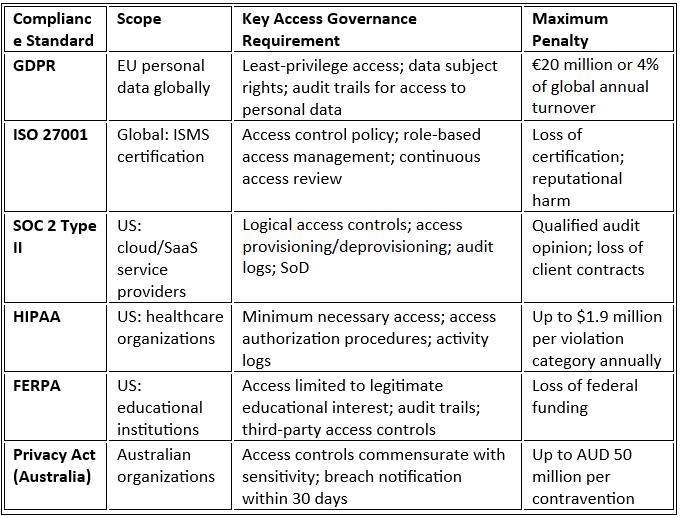
The common thread across all these frameworks is the principle of least privilege: users should have access only to the data and functions they need for their specific role, and that access should be reviewed, audited, and adjustable. This principle is not satisfied by provisioning that is merely convenient; it is satisfied only by provisioning that is precise.
What Auditors Actually Look For
When a compliance auditor reviews access governance in an Oracle HCM environment, the questions they ask are specific:
- Can you demonstrate that each user's role assignments were provisioned based on a documented, authorized process?
- Can you show that users do not have access to data outside their organizational scope?
- Can you evidence that access is reviewed and updated when a worker's role changes?
- Can you demonstrate that access is revoked promptly when a worker is terminated?
- Can you show that no user has a combination of roles that creates a separation of duties conflict?
Oracle's native framework answers several of these questions well. Termination-triggered role revocation, for example, is handled automatically through assignment status conditions in role mappings. The audit trail available through Oracle's Security Console since Release 10 supports access change documentation. These are genuine compliance strengths.
The questions that native provisioning answers less completely are those involving complex access scoping across employee groups, dynamic access monitoring between assignment events, and automated SoD validation across the full role estate. These are precisely the dimensions where AI augmentation adds compliance value.
How Oracle's Security Architecture Compares to the Market
Oracle HCM Cloud is one of three dominant enterprise HCM platforms globally, alongside Workday and SAP SuccessFactors. Understanding where Oracle's security model stands relative to its competitors helps contextualize both its strengths and the areas where AI augmentation creates the most value.
Security Architecture Comparison
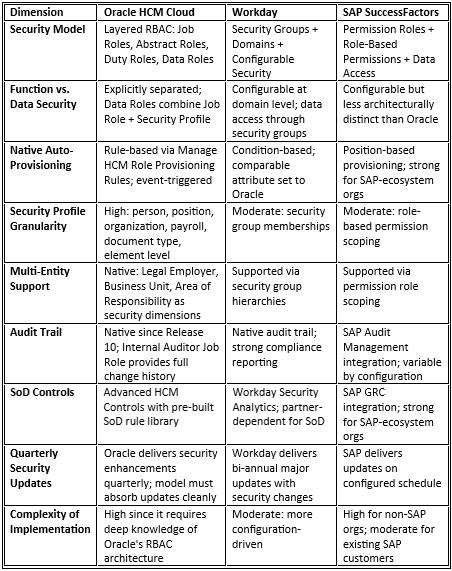
Where Oracle Stands Out
Oracle HCM Cloud features role-based access control, multi-factor authentication, and encryption, and supports compliance with GDPR, CCPA, and other regional regulations. But what distinguishes Oracle's security model at the architectural level is the explicit four-layer RBAC design and the formal separation of function security from data security.
In Workday, security is configured through security groups and domain policies - a flexible model, but one where the distinction between "what you can do" and "what data you can see" is expressed through configuration rather than architectural separation. In SAP SuccessFactors, permission roles govern access, but the granularity of data security scoping - particularly for multi-entity environments - requires more configuration effort to achieve the same precision that Oracle's Data Role architecture provides natively.
Oracle Fusion Cloud HCM supports multi-country payroll and compliance, making it suitable for global enterprises, especially in industries such as manufacturing, retail, healthcare, and financial services where complex payroll and HR processes are common. This global compliance depth is directly related to Oracle's security architecture: the ability to scope access by legal employer, business unit, and area of responsibility is what enables the platform to enforce jurisdiction-specific access controls without custom development.
Oracle HCM Cloud's functional depth comes with corresponding complexity as configuration options abound, but without disciplined governance, Oracle implementations can extend timelines and create overly elaborate solutions. This is an honest observation, and it reflects why security design expertise matters so much in Oracle environments. The platform's sophistication is an asset when correctly configured and a liability when it is not.
The Compliance-Provisioning Gap: A Quantified Risk
The connection between provisioning accuracy and compliance exposure is not abstract. The data is specific.
Data breaches compromised the personal information of over 1.7 billion individuals in 2024. The average cost of a data breach reached $4.88 million according to the 2024 IBM Security Report. The maximum fine for a GDPR violation is €20 million or 4% of annual global turnover, whichever is higher. Notable fines include Amazon (€746m) and WhatsApp (€225m).
For HCM environments specifically, the risk profile is heightened by the sensitivity of the data. Workforce data, including compensation, performance, health information, national identifiers, sits at the intersection of multiple compliance frameworks simultaneously. A single over-provisioned access configuration can create GDPR exposure, a SOC 2 finding, and a HIPAA violation in the same environment, depending on what data is accessible.
ISO 27001 focuses on internal security processes, SOC 2 validates how you protect customer data, and GDPR protects individuals in the EU/EEA whatever their citizenship, and applies to organisations that process their data. ISO 27001 is often expected in regulated industries, SOC 2 suits US-based SaaS and cloud vendors, while GDPR applies globally to anyone processing EU data.
For Oracle HCM customers operating globally – which describes most large enterprise deployments – compliance is not a single framework. It is a simultaneous obligation across multiple frameworks, each with its own audit cadence and penalty structure. The table below illustrates how access governance requirements map across the major frameworks relevant to Oracle HCM environments:
Access Governance Requirements by Compliance Framework
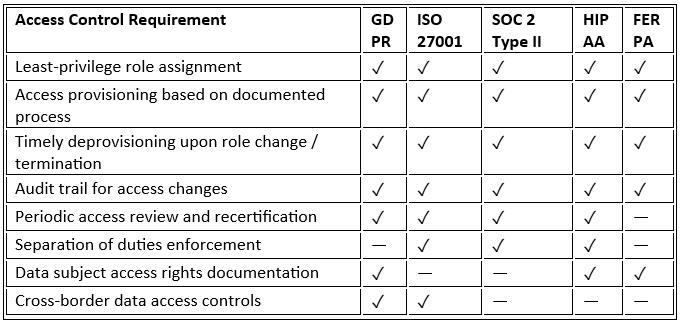
Every row in this table represents a provisioning requirement that Oracle's native framework addresses partially, while AI-augmented provisioning can address it more completely. Periodic access review and recertification is a requirement that native provisioning does not address at all, as it is fundamentally a monitoring and governance capability rather than a provisioning event.
The AI Opportunity: Extending What Oracle Already Does Well
The right framing for AI in Oracle HCM provisioning is additive, not substitutional. Oracle has built a genuinely robust security architecture. The RBAC model is sound. The Data Role framework is architecturally correct. The native provisioning engine is reliable for the scenarios it was designed to serve.
What AI adds is:
- Breadth — the ability to make provisioning decisions across a richer attribute set than rule-based logic can express
- Continuity — the ability to monitor access governance between provisioning events, not just at them
- Intelligence — the ability to learn from access patterns and recommend configurations that align with peer groups and organizational norms
- Compliance readiness — the ability to generate the evidence, recertification workflows, and access reports that compliance frameworks require, automatically and continuously
SOC 2 Type II assesses not only the design but also the operating effectiveness of controls over a defined period and this deeper review requires evidence of consistently enforced policies, logs, and processes. Generating this evidence manually, across a large Oracle HCM environment, is a significant administrative burden. AI-augmented governance reduces that burden by making evidence collection a continuous, automated process rather than a point-in-time audit exercise.
For organizations managing Oracle Fusion applications across multiple functional modules including HCM, Finance, Procurement and Supply Chain, the opportunity is even broader. AI positioned at the enterprise identity layer can evaluate access coherence across modules, identify cross-module SoD risks that neither module's native provisioning framework would surface independently, and optimize license consumption across the full suite.
How Axle HRM Approaches This Opportunity
Axle HRM's security practice is built on the conviction that Oracle HCM's security architecture is a genuine asset provided it is implemented correctly. The foundation must be sound before AI-augmented governance can add its full value: custom roles correctly derived from predefined ORA_ roles, security profiles applied through HCM Data Roles rather than directly to Job Roles, and a role estate that is clean enough for an AI layer to reason about accurately.
For organizations that have invested in getting that foundation right, we help identify the specific provisioning scenarios where AI augmentation would deliver the most value particularly in areas such as multi-group Employee access segmentation, cross-suite access coherence, compliance recertification automation, or license optimization modelling.
For organizations that are not yet there, our structured security design review provides the starting point: an assessment against Oracle's published best practices, a prioritized remediation roadmap, and a clear path from the current state to one where the platform's full capability - both native and AI-augmented - can be realized.
Why Organizations Trust Axle HRM With Their Security Practice
Axle HRM is an ISO-certified partner in data security and compliance and this certification reflects a systematic, documented and continuously audited approach to managing information security risk. The same discipline we apply to our own operations is the standard we bring to every client security engagement.
Axle HRM has also embarked on both SOC 2 and GDPR compliance programs. Our SOC 2 program provides independent assurance across the Trust Services Criteria of security, availability, processing integrity, confidentiality, and privacy. Our GDPR compliance commitment directly reflects the regulatory environment of the clients we serve across ANZ, the UAE, and multi-jurisdiction global enterprises where workforce data processing obligations are substantive and actively enforced.
When Axle HRM engages with an organization's Oracle HCM security design, the client's configurations and workforce data are handled within a framework that is independently validated, continuously maintained, and aligned with the same compliance standards we help our clients achieve.